

- This event is over. However, time travel possible through our Audio & Video! See upcoming events
The Worlds of Colonial Medicine
Empire, Ecologies, Entanglements
Speaker
In much literary scholarship, colonial medicine has been characterized as a site of racialized knowledge production, cultural denigration and counterinsurgent rhetoric. In her book Imperial Pharmakon, Sandhya Shetty acknowledges the bile on display in colonial discourse on native bodies, but maintains that medicine as a “tool of empire” was never consistently oppressive, evenly commanding, or unrelievedly prosaic in its articulations. Guided by the insight that “what makes power hold good, what makes it accepted, is simply the fact that it doesn’t only weigh on us as a force that says no, but that … it induces pleasure, forms of knowledge,” she tells a thick and tangled story about Western medicine’s divided enunciations and desultory goals, and, its erratic and errant reception on colonial soil.
Attentive to the diverse ways in which desire for and pleasure in self-improvement inspired Indians to bold even risky experiments, she argues that an exclusive focus on medicine’s combative posture risks singularizing what the archive nudges us to grasp as plural, volatile, and at times even generative. Reading this archive through a literary-critical lens, the book distills a rich, mixed brew of driving ideas and affects on both sides of the colonial divide, drawing out medicine’s ability to stir the imagination of better worlds, to liberate colonial subjects from ascriptive roles and to harbor a hostile war-making logic.
In her presentation, Sandhya Shetty will expand on the conceptual infrastructure that bolsters the empirical details of the historical figures and events she discusses. Keywords such as “biopolitics,” “ecology,” “entanglement,” and “pharmakon” are methodologically and substantively significant to her arguments, while the friend/enemy dyad and the notion of “hospitality” help to formulate the ethical impasses of medicine in colonial conditions. She will also address the question of the Medical Humanities and conclude with reflections on the potency of the pharmakon as it moves this century toward engineering “new humans,” quite unlike those birthed in colonial India circa 1835. The presentation will conclude with an audience Q&A.
Venue: Library
Speaker
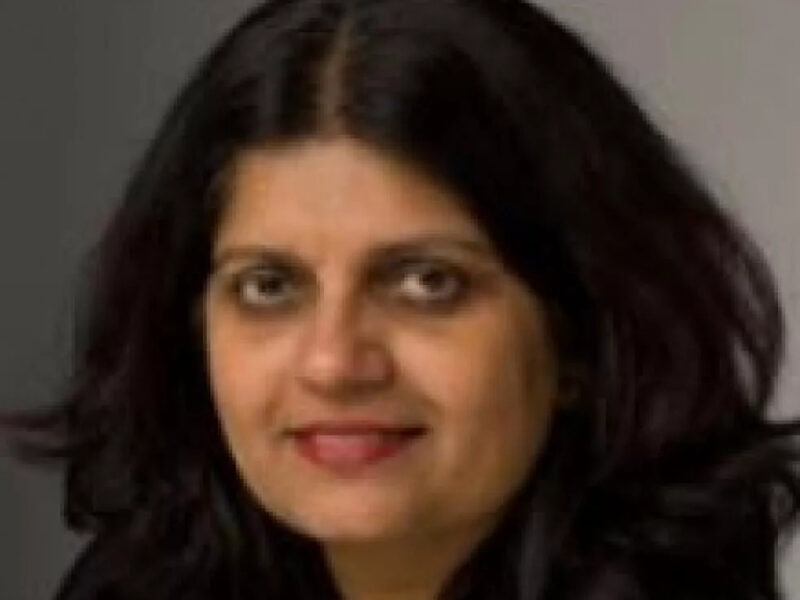
Sandhya Shetty
Sandhya Shetty is Professor of English at the University of New Hampshire, USA, where she teaches courses in Literature and Medicine, Postcolonial Literatures, and British Literature of the Nineteenth Century, with an emphasis on empire, biopolitical theory, animal studies, and the nonhuman. She has also had teaching stints in Japan and the UK.
Her research interests are wide-ranging. Apart from Anglophone literatures from Asia and Africa, they include the novel, gender theory, the medical humanities, and, most recently, literature and the question of the nonhuman in the Anthropocene. At the University of New Hampshire, she has served on the Governing Board of the Medical Humanities, Society and Ethics Program and as Coordinator of the Asian Studies Minor.
She has presented papers at numerous national and international conferences in Canada, Europe, and Australia, and her scholarly work has been published in major journals, edited collections, and special issues. Published in Diacritics, with an afterword by Gayatri Spivak, Sandhya Shetty’s co-authored article “Postcolonialism’s Archive Fever” is a much-cited contribution to revisionary scholarship on the concept of the archive. She has also written on contemporary postcolonial novelists Amit Chaudhuri, Michael Ondaatje, and others. An essay on Anandibai Joshi, the first Indian woman to earn an MD in the United States, appeared in New Directions in Literature and Medicine Studies, and another on Siddhartha Mukherjee, the Pulitzer Prize–winning author of The Emperor of All Maladies: A Biography of Cancer, appeared in Contemporary Physician-Authors (Routledge).
Sandhya Shetty is the author of Imperial Pharmakon: Writing and Medicine in the Long Nineteenth Century. Published by Palgrave Macmillan as part of its series on Literature, Science, and Medicine, it was shortlisted for the 2025 Book Award by the British Society for Literature and Science.
