
- This event is over. However, time travel possible through our Audio & Video! See upcoming events
On Stone and Sculpture
Isamu Noguchi and Early India
Speaker

Isamu Noguchi—one of the preeminent sculptors of the twentieth-century—wrote in 1949 that the ancient site of Mahabalipuram was his “first and most authentic lesson.” Between then and his death in 1988, Noguchi visited India at least eleven times. Yet there has been little investigation into the nature of this connection and the impact it had on the sculptor’s work. The few studies on the topic emphasize Noguchi’s interest in the architectural modernity of post-independence India.
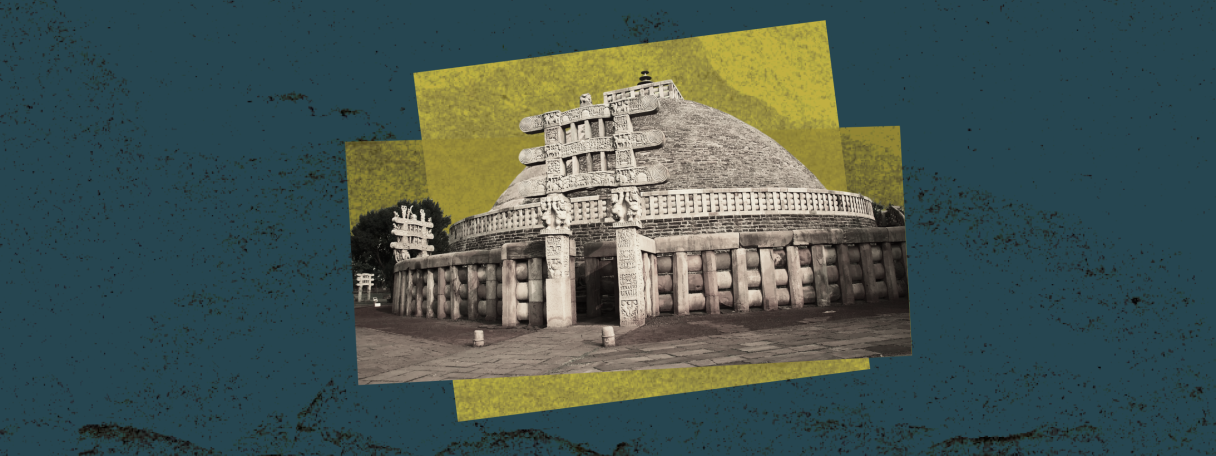
This talk explores instead the sculptor’s enduring attentiveness towards the stone sculpture of early India. It highlights Noguchi’s engagement with ancient sites such as Sanchi, Elephanta, and Mahabalipuram, among numerous others, and traces the centrality of the “matter of sculpture” in his approach. In looking at and alongside Noguchi, we expand not only our current understanding of the sculptor’s oeuvre but also the study of early Indian sculpture.
Speaker
Kalyani Madhura Ramachandran
Kalyani is an art historian of premodern South Asia. Her research focuses on early Buddhist art in the Deccan, its transmissions across South and Southeast Asia, and curatorial, colonial, and contemporary approaches to sculpture. She was previously a Research Assistant in the Department of Asian Art at the Metropolitan Museum of Art. Kalyani has a PhD from Columbia University, an MPhil from the University of Oxford on the Rhodes Scholarship, and a B.A. from the University of Delhi, where she received the Department of History Prize. She is currently a Postdoctoral Fellow at NYU Shanghai.
