
- This event is over. However, time travel possible through our Audio & Video! See upcoming events
New Insights on Mughal Art and Culture
Portraying the Mughal Queen Mother Hamida Banu Begum
Speakers


Reflections on Mughal Art and Culture, recently published, explores the rich aesthetic and cultural legacy of the Mughal Empire with new, insightful material researched by 13 leading scholars in the field. The articles in the book discuss varied subjects under the Mughal umbrella, challenge long-held ideas and draw comparisons between the artistic expressions and material culture of the powerful Islamicate triumvirate of the early modern period, the Safavids, the Ottomans and the Mughals. During the first half of this presentation, Roda Ahluwalia, editor of the book, will explore the diversity in chapters as well as common threads that run through them, unifying the book in aesthetic and cultural identity.
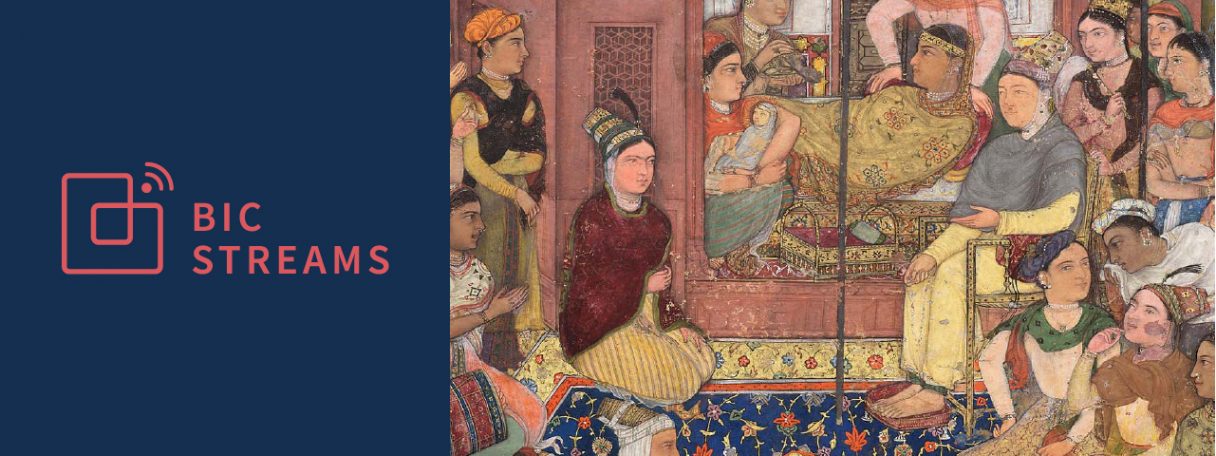
Dr. Mika Natif, a contributor to the book will discuss her new research on images of royal Mughal women illustrated in pages of historical manuscripts from the time of Emperors Akbar and Jahangir. Depicted in group portraits, these pictures reveal the importance of Mughal court ladies in the empire’s political and cultural life. One woman in particular, Hamida Banu Begum (b. ca 527-1604), stands out because of the sheer frequency of her appearance in court chronicle illustrations. No other Mughal female figure has enjoyed such prolific visual representation during her own lifetime. This session will focus on some portraits of Hamida Banu from the History of Akbar (Akbarnama) and the Memoirs of Jahangir (Jahangirnama). These paintings highlight her political stature and economic power, as well as her role in the formation of the dynasty’s Turko-Mongol identity, legitimacy, and prestige. Defying notions of royal female seclusion, her images challenge the modern day male-centered art historical discourse of Mughal portraiture.
In collaboration with Niyogi Books

Speakers
Roda Ahluwalia
Mika Natif
Mika Natif is Associate Professor of Art History at George Washington University. Her scholarly work focuses on the intercultural exchanges and global connections that Muslim societies forged with Europe during the premodern era. She is the author of Mughal Occidentalism: Artistic Encounters Between Europe and Asia at the Courts of India, 1580-1630 (Leiden: Brill, 2018). She also co-edited and co-authored, with Francesca Leoni, Eros and Sexuality in Islamic Art (Surrey: Ashgate Publications, October 2013). Her current research explores notions of female portraiture, diversity, and religious tolerance in the arts of Mughal India, and the role of women as patrons and artists in pre-modern Persianate spheres.
Prateeti Punja Ballal
Prateeti Punja Ballal grew up in Bangalore and did her postgraduate work in the US. She taught Literature at various universities there, most recently at Hunter College, City University of New York. She earlier worked in the software industry for fifteen years. She has been a recipient of a Mellon fellowship for her research and several regional and international awards for her technical publications. A musician and dancer, she has a sustaining interest in the arts.
