
- This event is over. However, time travel possible through our Audio & Video! See upcoming events
Nature’s Wild Child
The Unseen Side of Mangoes
Speakers

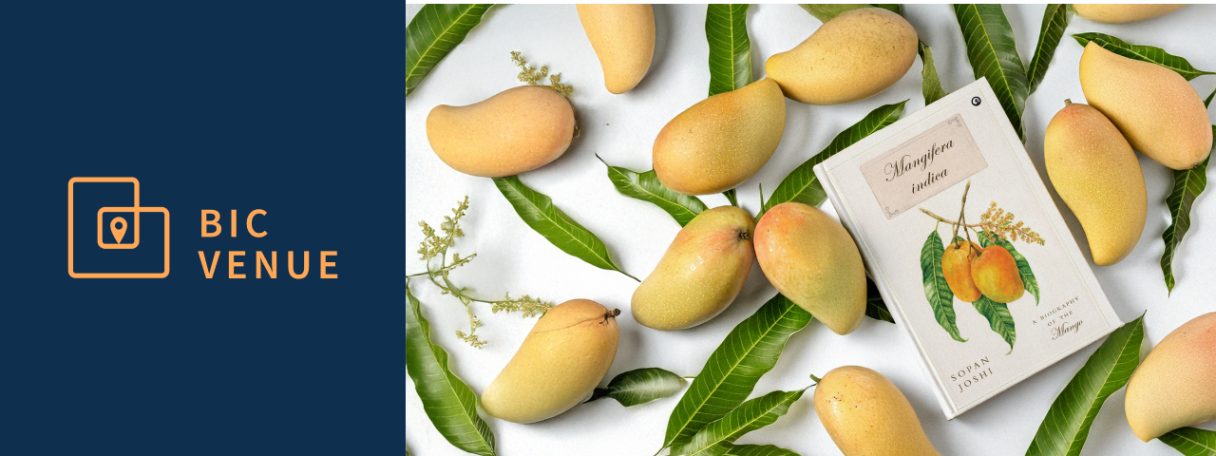
India has a unique relationship with the mango. It is all over our cultural life and festivals. Our emotional life and our social existence. Our markets and our countryside. It is the only fruit that is a festival unto itself. Each year, cities organize their own mango festivals that are extremely popular events. No other fruit seems to have a comparable role anywhere else. The mango seems intimately familiar to almost all Indians, nay, all residents of South Asia. Yet we are unaware of the wider role of the mango fruit, leaves, flowers, trees, orchards and groves in almost every facet of our lives through our known and unknown history. In politics, economics, land ownership, infrastructure, ecological (and psychological) health, propaganda, diplomacy, ecology, festivities, funerals, weddings, seduction, poetry, the arts, architecture…
Drawing from the recently published bestseller Mangifera indica: A Biography of the Mango, this discussion will join the ubiquitous excitement around mangoes to look towards avenues untrodden, histories unconsidered, festivals abandoned. The event will take place close to the time that marked India’s myriad spring festivals, the symbol of which was the mango flower. The known mango is a bridge to a lot about us that is either unknown or goes unacknowledged.
The author, Sopan Joshi will be in conversation with Venu Madhav Govindu which will be followed by a Q&A session with the audience.
Speakers
Sopan Joshi
Venu Madhav Govindu
Venu Madhav Govindu is on the faculty of the Department of Electrical Engineering, Indian Institute of Science. His area of professional research is geometric estimation in computer vision. He also has an interest in the history of modern India, especially the life and work of Mahatma Gandhi. He has co-authored a biography of the Gandhian economic philosopher and constructive worker, J. C. Kumarappa. He shares with millions of fellow Indians a love for mangoes.
