
Speakers

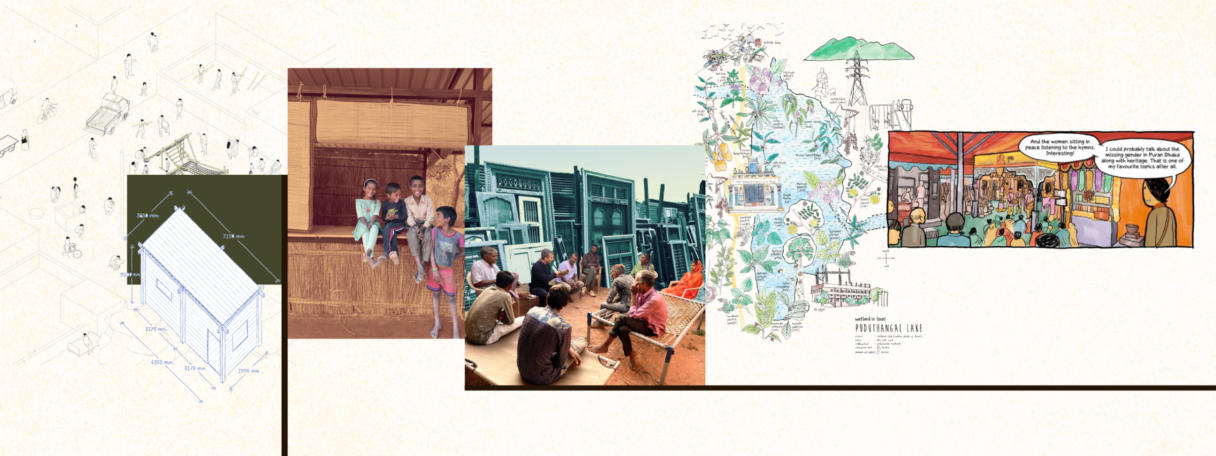
Across South Asia, some of the most authentic and quietly radical design is happening at the margins of the profession: in studios working with displaced communities, in student theses that take gender and labour seriously as design questions, and in collectives building in disaster-prone zones. This talk discusses the role of design and architecture in shaping positive social impact across the region. Can architecture and design be practices of collective care rather than individual authorship?
Practitioners are already proving this to be true. Professionals and students are working with fishermen to rebuild flood-prone coastlines, training self-help groups to construct their own schools, and documenting vernacular knowledge before it disappears. Together, these projects suggest that architecture’s most urgent role today may be relational rather than aesthetic: a tool for redistributing agency over the built environment.
This event is part of a series of exhibitions, “A Common Ground,” held across Mysuru and Bengaluru, from 26 October to 6 November 2026.
In collaboration with:


Venue: Auditorium
Speakers
Saif Ul Haque
Saif Ul Haque is the principal architect at Saif Ul Haque Sthapati in Dhaka, Bangladesh. His works include residential, institutional and industrial facilities across Bangladesh, some of which have been published, exhibited and received awards in Bangladesh and abroad. He has an active interest in research on environment, architecture and the city, and has written and given talks on these topics. He has also been involved in organising several architecture exhibitions.
Shubhra Raje
Shubhra Raje is an architect and educator, and founder of Shubhra Raje built environments. She is Adjunct Professor and Chair of Architectural History and Research at CEPT University. Her work spans cultural, educational and social spaces in India and the United States, community initiatives in Colorado, and earthen structure conservation in Egypt. Designing, building and teaching sustain an inquiry into how architecture can enlarge the possibilities of everyday life. Her experiments with space, materials and construction question building conventions.
Anand Sonecha
SEALAB is an Ahmedabad-based architecture practice founded by Anand Sonecha, a graduate of IPSA, Rajkot. He began with projects at Sabarmati Ashram, renovating dilapidated historic houses into homes for Ashram volunteers and building the Jai Jagat Theatre for the Ashram’s centenary celebrations. Other works include the School for Blind and Visually Impaired Children, Gandhinagar, and Gram Setu, a community centre for farmers of Meghraj District. His approach is slow, contemplative and open-ended, engaging rigorously with place, both seen and unseen.
Varna Shashidhar
Varna Shashidhar works at the intersection of landscape architecture and ecological memory. Trained at RVCE and Harvard’s Graduate School of Design, she returned to India to found VSLA, a regional practice working across South Asia. Her work, in landscape and through Design United, has focused on community building. Design United, founded in March 2020, is a non-commercial platform building critical culture for emerging designers and students across South Asia through connection, collaboration, dialogue and mentorship.
Jayesh Ganesh
Jayesh Ganesh co-founded UCS Architecture in 2016 with Uday Goswami. It is a social impact practice working at the grassroots with communities and NGOs across India. UCS works with traditionally underserved or marginalised people and communities who have little or no representation in dominant public discourse, emphasising listening, learning and working with communities to develop spaces and processes. Jayesh is also co-founder of BBLOX Design, with Gauri Gore. He studied at VNIT Nagpur and CEPT University, and completed the Young India Fellowship.
