
- This event is over. However, time travel possible through our Audio & Video! See upcoming events
328. From Thought to Action
Aruna Roy, TM Krishna, Deepa Ganesh and Gautam Bhan with Aakar Patel
Speakers


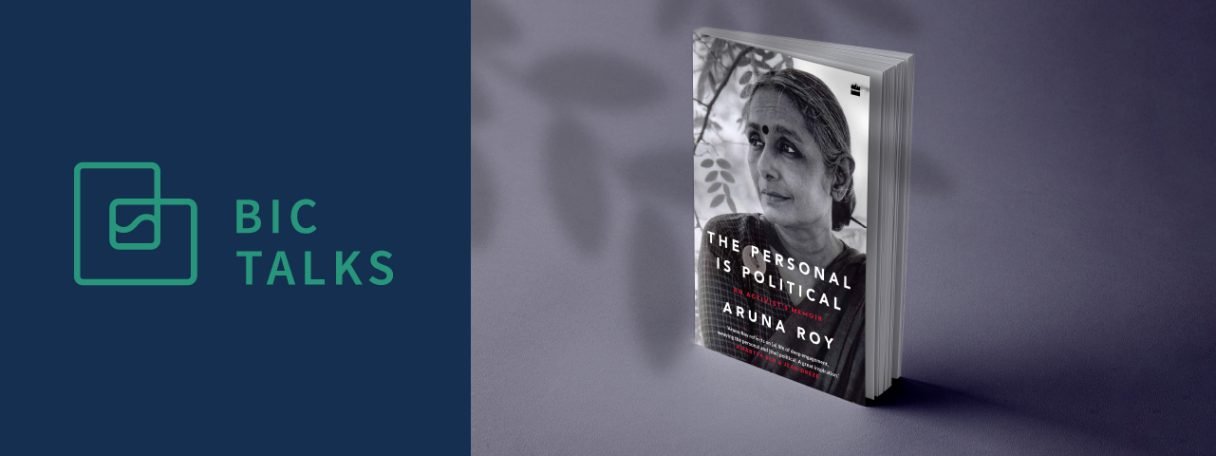
Magsaysay Award-winning social activist Aruna Roy’s memoir is the story of two parallel journeys—a fifty-year-long engagement with public action in India, and a personal narrative that traces how the author has striven to convert her ideological convictions into practice.
For long decades, Aruna Roy has lived with and worked for the benefit of marginalised communities in rural India, fighting for the right to survive in a hostile environment. Alongside accounts of the plight of the vulnerable and the transformative power of mass-based grassroot social movements, her recollections are marked with stories of resilient individuals and communities and their extraordinary resistance to oppression. Roy recounts a powerful lesson learnt from her extraordinary life: that every issue, whether it is poverty, discrimination, inequality or corruption, has personal as well as political ramifications. It is only by connecting the personal and the political, Roy says, that each one of us can make a difference.
In this episode of BIC Talks, Aruna Roy will be in conversation with Aakar Patel, alongside TM Krishna, Deepa Ganesh and Gautam Bhan. This is an excerpt from a conversation that took place in the BIC premises in August 2024.
Subscribe to the BIC Talks Podcast on your favorite podcast app! BIC Talks is available everywhere, including Apple Podcasts, Spotify, Google Podcasts, Castbox, Overcast, Audible and Amazon Music.
Speakers
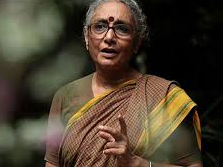
Aruna Roy
Aruna Roy is one of India’s most prominent activists. She was a civil servant from 1968 to 1975. In 1975 she resigned from the Indian Administrative Service to work with the rural poor in Rajasthan. Along with Nikhil Dey, Shankar Singh, and several others from the local community in Devdungri district, she collectively formed the MKSS Mazdoor Kisan Shakti Sangathan (Organisation for the Empowerment of Workers and Peasants) in 1990. The MKSS played a pivotal role in drafting and advocating for the Right to Information Law which was passed by the Indian Parliament in 2005. She has also worked with campaigns for the access of the poor to constitutional rights for equality and justice- the Right to Work, Food Security and the Peoples’ Union for Civil Liberties.
She is a prominent member of many democratic struggles and campaigns, and currently is the President of the National Federation of Indian Women (NFIW). She was awarded the Ramon Magsaysay Award in 2000, the Nani Palkiwala Award and the Lal Bahadur Shastri National Award for Excellence in Public Administration, Academia and Management in 2010, and listed as one of the 100 most influential people in the world by the TIME Magazine for 2011.
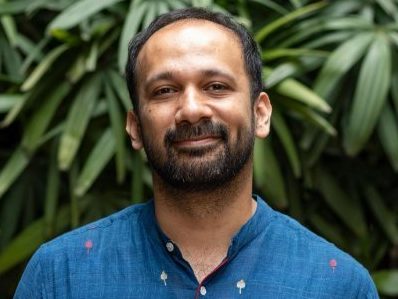
TM Krishna
T.M. Krishna, a renowned vocalist in the Karnatik tradition, defies standard musical analysis with his unique and innovative renditions. As a public intellectual, Krishna addresses cultural and societal issues through his writings and initiatives. He co-authored Voices Within: Carnatic Music – Passing on an Inheritance and penned the award-winning A Southern Music – The Karnatik Story” His essay “MS Understood” was featured in The Caravan Book of Profiles and translated into Tamil. In Reshaping Art, Krishna explores art’s creation and its socio-political implications. His work, Sebastian and Sons delves into the history of the mridangam.
Krishna has collaborated on projects like the Chennai Poromboke Paadal, performed with transgender musicians, and pioneered the Chennai Kalai Theru Vizha. His partnership with Tamil writer Perumal Murugan and efforts to integrate Narayana Guru’s poetry into Karnatik music are notable. He leads The Edict Project with Ashoka University, reimagining Ashoka’s edicts in musical form.
Krishna received the Ramon Magsaysay Award in 2016 for using art to bridge social divides and the Indira Gandhi Award for National Integration in 2017. He also won the Professor V Aravindakshan Memorial Award for making Carnatic music accessible to the common man.
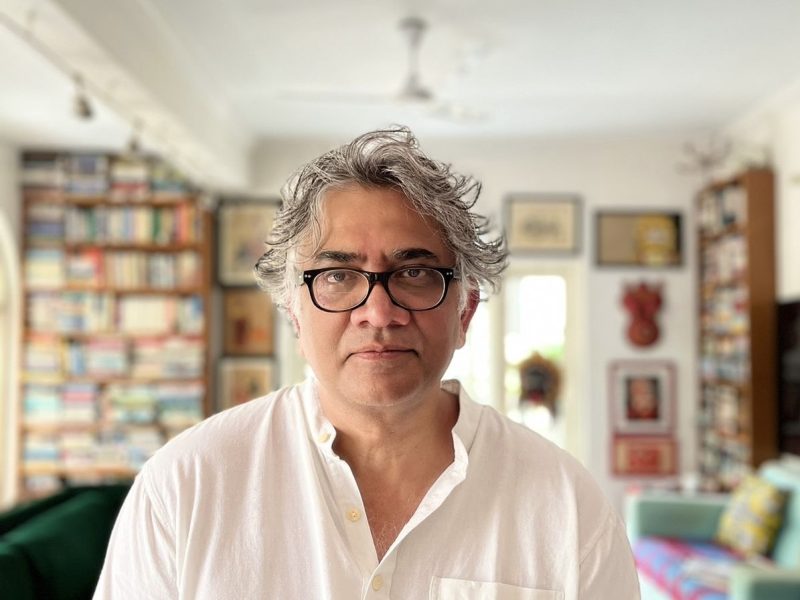
Deepa Ganesh
Deepa Ganesh served as Deputy Editor at The Hindu for two decades. Currently she is Professor and Executive Director, Centre for Visual and Performing Arts, RV University. She is the author of A Life In Three Octaves – The life and Times of Gangubai Hangal. Ganesh has also translated U.R. Ananthamurthy’s short stories, and the memoir of the early Kannada writer Saraswati Bai Rajwade by Vaidehi. Ganesh is a translator and journalist.
Gautam Bhan
Gautam Bhan is an urbanist whose work focuses on urban poverty, inequality, social protection and housing. He is currently Associate Dean, IIHS School of Human Development, as well as Senior Lead, Academics & Research, at IIHS.
Gautam’s previous research has focused on evictions, citizenship and inequality in Delhi, and at IIHS, he continues to work on questions of access to affordable and adequate housing. He anchors IIHS’ role as a National Resource Centre with the Ministry of Housing and Urban Affairs, Government of India. He is also a part of IIHS’ work in affordable housing policy and practice, having worked with housing rights movements across the country as well as state governments in Karnataka, Delhi, Rajasthan and Odisha. His new work engages with regimes of urban welfare and social security, including work on urban health. At the School of Human Development, he is building research and practice on questions of the design and delivery of social protection entitlements within urban India. He also has a deep and abiding interest in new urban and planning theory from the South.
He is the author of In the Public’s Interest: Evictions, Citizenship and Inequality in Contemporary Delhi (University of Georgia Press, 2017; Orient BlackSwan, 2017), co-editor of the Routledge Companion to Planning in the Global South (Routledge, 2018; Orient BlackSwan, 2019), co-author of Swept off the Map: Surviving Eviction and Resettlement in Delhi (Yoda Press, 2008), and co-editor of Because I have a Voice: Queer Politics in India (Yoda Press, 2006), in addition to numerous academic articles. He also writes frequently in public intellectual spaces. He holds a PhD in urban studies and planning from the University of California, Berkeley.
Aakar Patel
Aakar Patel is a syndicated columnist who has edited English and Gujarati newspapers. His books include Why I Write, a translation of Saadat Hasan Manto’s Urdu non-fiction (Tranquebar, 2014), Our Hindu Rashtra: What It Is. How We Got Here, a study of majoritarianism in India and Pakistan (Westland, 2020), Price of the Modi Years, a history of India after 2014 (Penguin Random House, 2021), The Anarchist Cookbook, a guide on why and how to protest (HarperCollins, 2022) and the novel After Messiah (Vintage, 2023). His work reimagining South Asia, ‘The Case For Akhand Bharat’, is out in 2024. He is Chair of Amnesty International India.
