
- This event is over. However, time travel possible through our Audio & Video! See upcoming events
277. Histories of a Civilisation (Part 1 of 7 with Tony Joseph & GN Devy)
The Migrations that Shaped Indian Demography
Speakers

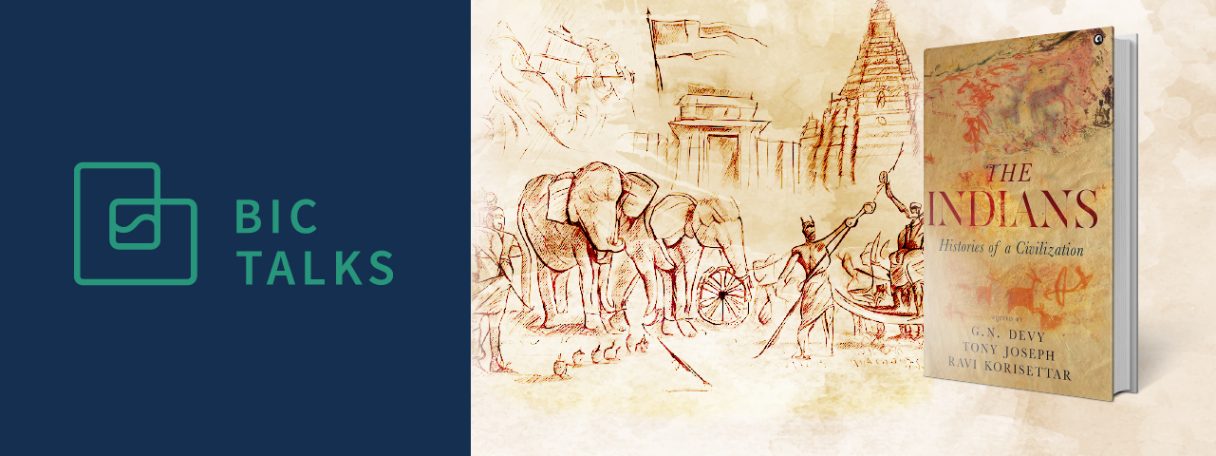
The Indians is a collection of essays by some of South Asia’s foremost historians and scholars that maps the origins, evolution, and present-day reality of India’s civilisation and people. The collection covers a period of some 12,000 years-from the last Ice Age to the twenty-first century.
The book is divided into seven sections – the first part looks at the evolution of humans in South Asia through the lens of the early ‘Indian’ population, their migrations, and the climate. The second part focuses on the emergence of different civilisations in the region through the domestication of plants and animals and other factors and how these civilisations eventually begin to decline. The third part discusses the languages and philosophies that defined ancient India-Buddhism, Jainism, Sanskrit, Indo-Iranian languages, and Pali literature, among others. The fourth part is a detailed study of society and culture in various geographical regions–the North, South, Northeast, the Deccan, East, and West India. The fifth part looks at the advent of colonialism and its impact on the country’s economy, social fabric, and knowledge systems. The sixth part looks at Adivasi movements, Ambedkarite politics, Gandhian resistance, and other events that would come to form the bedrock of the independent republic. And, finally, the seventh part looks at contemporary India–the workings of the Constitution and urbanism, liberalisation, and other aspects of the modern Indian experience.
Taken together, the essays in the book provide remarkable insights into Indian history and society. An attempt has been made to reflect these sections to an extent in this seven part series.
This BIC Talks mini series – Histories of a Civilisation – glimpses into the collection, presenting readings from selected essays, interspersed with conversations with the scholar who wrote them, providing a sampling of the various topical discourses that cover the epochs of the subcontinent and hopes to encourage our listeners to take a deep dive into what makes the Indians.
In this first part, journalist and editor Tony Joseph speaks to fellow editor ‘The Indians’, GN Devy while reflecting on migrations that shaped the demography of India.
Subscribe to the BIC Talks Podcast on your favourite podcast app! BIC Talks is available everywhere, including Apple Podcasts, Spotify, Google Podcasts, Castbox, Overcast, Audible and Amazon Music.
Speakers
Tony Joseph
Tony Joseph is an Indian journalist and former editor of Businessworld magazine. He is also the author of the best-selling book Early Indians: The Story of Our Ancestors and Where We Came From (2018). Until 2018, he was also the chairman and co-founder of Mindworks Global Media Services. He is based in New Delhi. Joseph has been an editor and a journalist for over three decades and was, at various times, features editor of The Economic Times, associate editor of Business Standard and editor of Businessworld magazine (from 1998). His articles have appeared in Outlook India, Quartz, Live Mint and The Hindu.
Early Indians is focused on four prehistoric migrations that shaped the demography of India, including the migrations after 2000 BC.
GN Devy
Ganesh N Devy is a thinker, cultural activist and an institution builder best known for the People’s Linguistic Survey of India and the Adivasi Academy created by him. He writes in three languages—Marathi, Gujarati and English. His first full length book in English After Amnesia (1992) was hailed immediately upon its publication as a classic in literary theory. Since its publication, he has written and edited close to ninety influential books in areas as diverse as Literary Criticism, Anthropology, Education, Linguistics and Philosophy.
G N Devy was educated at Shivaji University, Kolhapur and the University of Leeds, UK. Among his many academic assignments, he held fellowships at Leeds University and Yale University and has been THB Symons Fellow (1991-92) and Jawaharlal Nehru Fellow (1994–96). He was Professor of English at the Maharaja Sayajirao University of Baroda (1980-96). In 1996, he gave up his academic career in order to initiate work with the Denotified and Nomadic Tribes (DNT) and Adivasis. During this work, he created the Bhasha Research and Publication Centre at Baroda, the Adivasis Academy at Tejgadh, the DNT-Rights Action Group and several other initiatives. Later he initiated the largest-ever survey of languages in history, carried out with the help of nearly 3000 volunteers and published in 50 multilingual volumes.
