
- This event is over. However, time travel possible through our Audio & Video! See upcoming events
242. Dynamics of Rural Democracy (with Mukulika Banerjee & Vijayendra Rao)
An Ethnographic Insight
Speakers

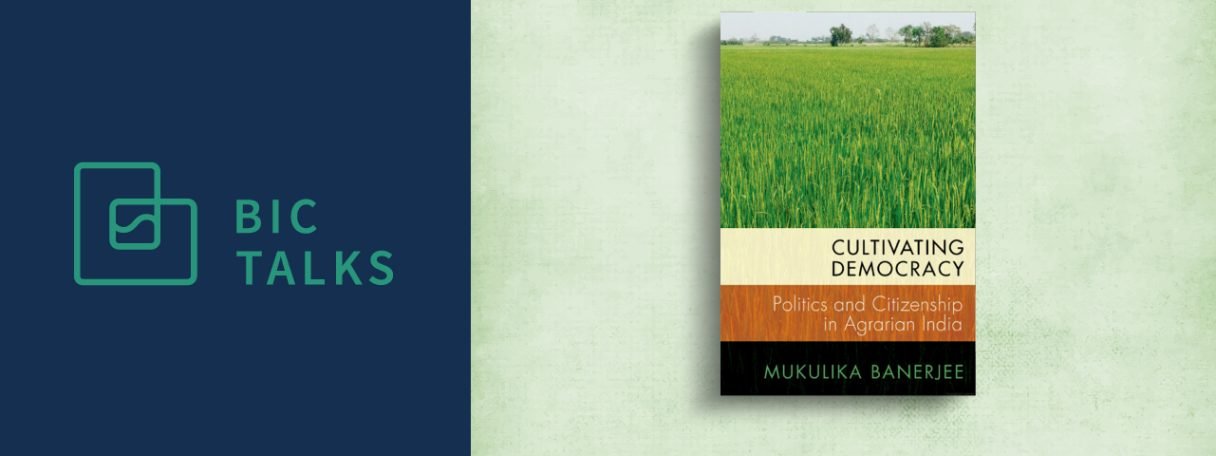
An ethnographic study of Indian democracy that shows how agrarian life creates values of citizenship and active engagement that are essential for the cultivation of democracy, Cultivating Democracy provides a compelling ethnographic analysis of the relationship between formal political institutions and everyday citizenship in rural India.
Dr. Mukulika Banerjee draws on deep engagement with the people and social life in two West Bengal villages between 1998 and 2013 to show how the micro-politics of their day-to-day life builds active engagement with the macro-politics of the state. Her sensitive analysis focuses on several “events” in the life of the villages shows how India’s agrarian rural society helps create practices and conceptual space for citizens to be effective participants in India’s great democratic exercises.
In this episode of BIC Talks, Dr. Banerjee, social anthropologist, scholar and author engages in a coversation with scholar and economist Dr. Vijayendra Rao on the various facets of a functioning democracy and lessons the urban set ups can learn from rural governance.
Subscribe to the BIC Talks Podcast on your favourite podcast app! BIC Talks is available everywhere, including iTunes, Spotify, Google Podcasts, Castbox, Overcast and Stitcher.
Speakers
Mukulika Banerjee
Dr. Mukulika Banerjee is an anthropologist and author whose new monograph, “Cultivating Democracy: Politics and Citizenship in Agrarian India” (OUP New York), was published in October 2021. The book focuses on the relationship between formal political democracy and active citizenship in a rural setting in West Bengal. Spanning the years 1998 to 2013, the study draws on deep ethnographic engagement with two villages, examining their social life and political dynamics during elections and in between. Dr. Banerjee’s research sheds light on how these temporalities intersect and contribute to the cultivation of democracy.
Her previous book, “Why India Votes?” (Routledge 2014), funded by a major ESRC Grant, explored the reasons behind the continuous rise in India’s voter turnout despite socioeconomic disparities and infrastructure challenges. Through a socio-politico-anthropological narrative, Dr. Banerjee examined the significance of participative political behavior in a country characterized by inequality and a rural-urban divide.
Dr. Banerjee’s interest in the cultural meanings of democracy in South Asia led her to produce a BBC Radio 4 documentary on “Sacred Elections” during the Indian national elections in 2009. She has also received a grant from the Indo-European Networking Programme in the Social Sciences for her project EECURI (Explanations of Electoral Change in Urban and Rural India), which expands the analysis to state and Panchayat elections.
Beyond her research, Dr. Banerjee has applied anthropological methods to political behavior and served as the founding Series Editor of the “Exploring the Political in South Asia” series (Routledge). Her academic engagement extends to lectures and presentations at numerous institutions worldwide, spanning cities such as New York, London, Paris, Delhi, and Yale.
Dr. Banerjee’s wider academic pursuits include her doctoral research on the non-violent Pakhtun movement in Pakistan’s Khyber-Pakhtoonkhwa, published as “The Pathan Unarmed: Opposition and Memory in the Northwest Frontier” (James Currey, 2001). She has also co-authored works such as “The Sari” (Berg, 2003), which explores the survival and cultural significance of this iconic South Asian women’s clothing, and edited volumes like “Muslim Portraits: Everyday Lives in India” (Indiana University Press, 2008), providing nuanced perspectives on Muslims in contemporary India.
Through her interdisciplinary approach, Dr. Banerjee breaks stereotypical categories and offers a textured engagement with anthropology, intertwining the social and political dimensions of her research.
Vijayendra Rao
Vijayendra (Biju) Rao, a Lead Economist in the Development Research Group of the World Bank, works at the intersection of scholarship and practice. He integrates his training in economics with theories and methods from anthropology, sociology and political science to study the social, cultural, and political context of extreme poverty in developing countries.
His research has spanned a variety of subjects. In his early work he pioneered empirical research in Economics on dowries, domestic violence and sex work. His 2004 edited book with Mike Walton, Culture and Public Action, was an effort to instigate a conversation between anthropologists and economists to open up (then) new questions at the intersection of culture and development including the role of aspirations, inequality traps, and cultural heritage. He has had a long standing interest in Political Economy and democratic decentralization in India. He is a proponent of mixing qualitative and quantitative methods to make economics more reflexive, and to better understand and diagnose issues in development. His recent work has focused on participatory approaches to development, deliberative democracy, and voice and agency among the poor. He has been experimenting with the use of Natural Language Processing methods to understand epistemic discrimination in Indian village meetings, and to develop tools to analyze open-ended qualitative interviews at scale. He and Ghazala Mansuri co-authored Localizing Development: Does Participation Work? which the Nobel Laureate Roger Myerson has described as “one of the most important books in development in recent years.” His most recent book, co-authored with Paromita Sanyal, is Oral Democracy: Deliberation in Indian Village Assemblies (Cambridge University Press).
Dr. Rao obtained a BA in Economics from St. Xavier’s College, Bombay University, a PhD in Economics from the University of Pennsylvania, was a Hewlett post-doctoral fellow at the Economics Research Center and an Associate of the Committee on Southern Asian Studies at the University of Chicago. He held faculty appointments at the University of Michigan and Williams College, and was on sabbatical at Brown University, before joining the World Bank’s research department in 1999.
He is a Fellow of the International Economics Association, and the Chair of the Advisory Committee of the program on Boundaries, Membership and Belonging, at the Canadian Institute for Advanced Research.
