
- This event is over. However, time travel possible through our Audio & Video! See upcoming events
Gender in the Built Environment
Expanding Agency and Archival Silences
Speakers




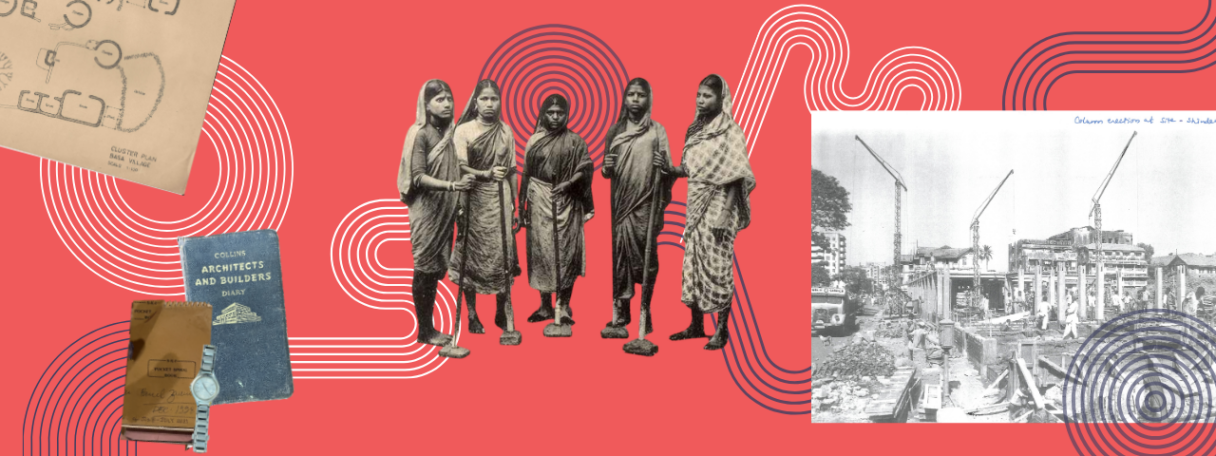
This inaugural discussion launches the Bangalore edition of the exhibition, “Expanding Agency and Archival Silences”. Panellists will foreground questions of gender and agency within spatial design practices in India, and lay the foundation for the upcoming walkthroughs, discussions, and workshops. Agency is negotiated, marked, and expanded in multiple ways.
In the current socio-political climate and technological transformation, why is it important not just to think about it, but to build practices that expand agency?
Particularly, why should it matter to architects, planners, and designers?
What tools, methods, or frameworks do you recommend for introducing and including diverse voices into the practices of building living environments?
Across the five days, a series of activities brings together conversations, lived experiences and participatory practices to explore how gender shapes the ways we design, build, inhabit, teach, and resonate with the ‘space’. Curators will be in conversation with practitioners from across borders to make space for care, compassion, responsiveness, and nuanced understandings of inhabitable spaces for co-existence.
Emerging thoughts will pave the path for continued engagements on the subject within the region, and across borders and disciplinary boundaries.
This event is a part of the “Expanding Agency and Archival Silences” exhibition. Find the BIC schedule here.
View the complete list of events here.
In collaboration with:




Venue: Seminar Halls
Speakers
Kathleen James-Chakraborty
Dr. Kathleen James-Chakraborty is a professor of art history at University College Dublin, who has also taught at UC Berkeley and the Yale School of Architecture. Her books include Architecture since 1400 (Minnesota, 2014), The Belgian Friendship Building (Virginia, 2025), and Minding Her Business: Women, Architecture, and Design (Leuven, 2026). She was an Ailsa Mellon Bruce Senior Fellow at the National Gallery of Art, Washington, D.C., and holds a European Research Council Advanced Grant for Expanding Agency: Women, Race, and the Dissemination of Modern Architecture.
Amit Srivastava
Amit Srivastava is Director (Indian Ocean Rim) at the Centre for Asian and Middle Eastern Architecture (CAMEA), Adelaide University. His book India: Modern Architectures in History (University of Chicago Press, 2015/2024), co-authored with Peter Scriver, traces architectural modernity in India from colonial PWD enterprise to postcolonial struggles. His upcoming book, SOUTH-SOUTH: The Architecture of Non-Alignment and Cooperation (NUS Press), explores transnational exchange across the Global South. His work has been shown at SOS Brutalism (DAM, Frankfurt, 2017) and The Project of Independence (MoMA, 2022).
Ranjana Raghunathan
Dr. Ranjana Raghunathan is an anthropologist and Assistant Professor at Vidyashilp University, Bangalore, researching urban ethnography, intimacies and religion, and everyday life philosophy. She set up an Ethnography Lab exploring these interests through research, pedagogy, and practice. She received her PhD from the National University of Singapore and Master’s from TISS, Mumbai, with her doctoral thesis winning the Ground-breaking Subject Matter Accolade at the 2021 International Convention of Asia Scholars Book Prize. She previously worked over a decade in development, on gender inequality and migrant rights. Before her academic career, Ranjana was engaged with the development sector for more than a decade and has worked on issues of gender inequality and migrant workers’ rights in Singapore, and homelessness in Mumbai.
Krishnapriya Rajshekar
Krishnapriya Rajshekar is an architect and academic based in Mysore, focused on the overlaps between architecture, art history, literature, visual culture, and the city, explored in her graduate thesis The Art Biennale Phenomenon (CEPT University, 2017). She won the CEPT Essay Prize 2018. She is Domain Head for History, Theory and the Humanities at Wadiyar Centre for Architecture (WCFA), Mysore, and runs its Architectural Journalism & Writing Elective. She edited Dotting the Curve (WCFA Press, 2025).
Madhumati A
Dr. A. Madhumathi is a Professor at the School of Architecture, Vellore Institute of Technology (VIT), India, with over two decades of experience in architectural education, research and practice. Trained in architecture, landscape architecture and energy-efficient architecture, her research explores the intersections of the built environment, climate responsiveness, vernacular architecture, heritage, and emerging computational approaches to design. Her work has increasingly engaged with questions of cultural identity, spatial inclusivity and gender in the built environment, including research on gender inclusivity in domestic space through the study of Chettinad vernacular architecture.
She has led externally funded research projects, published widely in architectural and building-performance research, and organised international academic platforms including ZEMCH 2024. As an educator and researcher, she is interested in bringing together environmental performance, cultural knowledge and critical spatial inquiry to rethink how architecture is conceived, documented and experienced.
Ishita Shah
Ishita Shah is trained as an interior designer and architectural historian. Over the last decade, she has developed a community-based curatorial practice focused on cultural preservation across India and South Asia, including Constructing Personal Archives, an incubation program for aspiring archivists, and the Women of Vaastukala Archive, a digital oral history repository, both under her collective, Curating for Culture. She currently consults as archivist/curator with the Pattani Archives, Glenmorgan Estate, and Anthology A+C, and is a recipient of several fellowships.
Sarah Melsens
Sarah Melsens is an architect and Marie Skłodowska-Curie Postdoctoral Fellow at CNRS and FLAME University, Pune, researching the history and ethnography of architecture and construction in colonial and postcolonial India. She co-edits the journals Architecture Beyond Europe (ABE Journal) and Construction History, and is a founding trustee of the Pune Architectural History Archive. She has taught at various architecture colleges in India, including CEPT University, and co-founded the scholarly network Platform for Architectural Transfers in the Indian Ocean rim (PATIO).
