
- This event is over. However, time travel possible through our Audio & Video! See upcoming events
Stilling
A Contemporary Dance Piece
Performer
Stillness is not the absence of motion. It is motion in perfect opposition to itself.
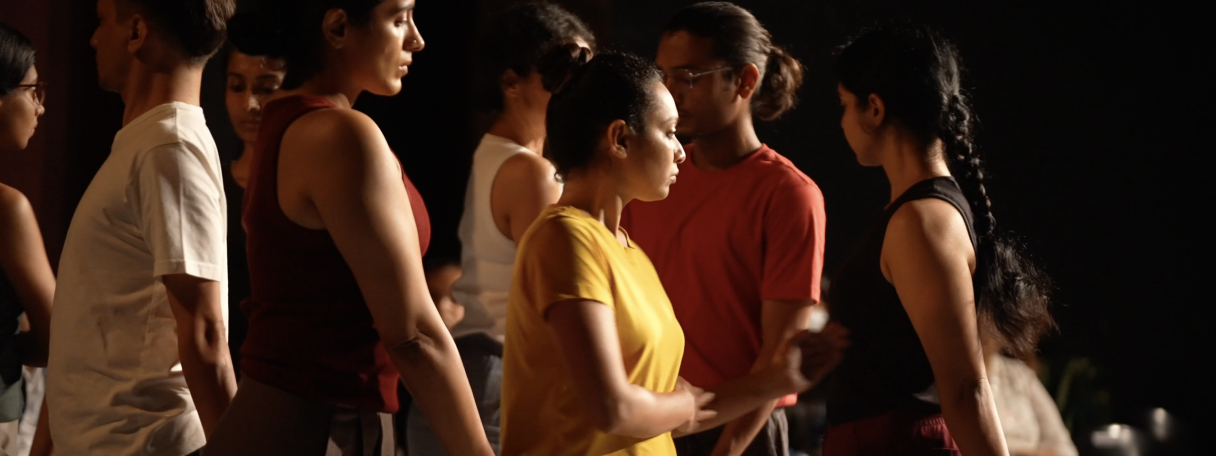
Two forces rotating in opposite directions meet at a single point. What they produce is not rest, but a stillness that contains both beginning and end. Perfect containment.
Ten dancers begin with short studies, building a vocabulary of contradictions with almost algebraic precision. They are disjointed and interconnected at the same time. The performance does not ask you to watch it unfold. It pulls you inward.
Into the counter. Into the disquiet. Into Stilling.
Credits:
Choreography: Padmini Chettur
Sound: Maarten Visser
Dancers: Aarabi Veeraraghavan, Anoushka Kurien, Madhushree Basu, Masoom Parmar, Pradeep Gupta, Priyakshi Agarwal, Ramya Shanmugam, Revati Shah, Sravanthi Vakkalanka, Tushti Aravind
This is part of the 7th Edition of Prakriti Excellence in Contemporary Dance Awards (PECDA). This is the first of three full length showcase performances in 2026 PECDA.
In collaboration with:

Performer
Padmini Chettur
Padmini Chettur began her contemporary dance career in 1990 as a member of the troupe of Chandralekha—the radical Bharatanatyam modernist choreographer, whose own opus dealt with a rigorous deconstruction of the form. Over the past two decades, Chettur has defined her own choreographic idiom—minimalist, abstract and formal—stripping movement down to an essential, anatomical investigation, prioritising a sense of tension over emotion. Since her solo work Beautiful thing 2 (2011), and in later works—Wall dancing (2013), Varnam (2016) — her work has been seen in visual art spaces like steirischer herbst (Graz), Kochi-Muziris Biennale (Cochin), National Museum of Modern and Contemporary Art (Seoul), Jejak-Tabi (Jogja), Haus der Kulturen der Welt (Berlin), Archive (Berlin), hangar Bicocca (Milan) as her practice extended into film and durational works. Her most recent work ‘A slightly curving place’, premiered at Concrete (Dubai) and will be shown at EMPAC (New York) in November 2023.
Padmini embarks on the research and development of each new work with a set of precisely articulated choreographic concerns. Her approach to movement research is almost scientific in rigueur. From Wings and Masks (1993) till date, throughout her oeuvre there is a deliberate concern with constantly refining form. The development of this concern yields a stark yet rich aesthetic in her work that is far removed from any obvious Indian classical dance context—a path that had its seed in her exposure during working with Chandralekha. As both choreographer and performer, Padmini has forged an overarching creative approach that pulls focus to the form and movement of the body. Early on, in her journey as a dance-maker, she took a very conscious decision not to train formally abroad—a decision which points to her well-formed politics. Her work—highly abstract in nature—is rooted in the cultural fabric of the uniquely engaged dance community of Chennai.
