

- This event is over. However, time travel possible through our Audio & Video! See upcoming events
Venomous Threat
Tackling India’s Snakebite Crisis
Speakers
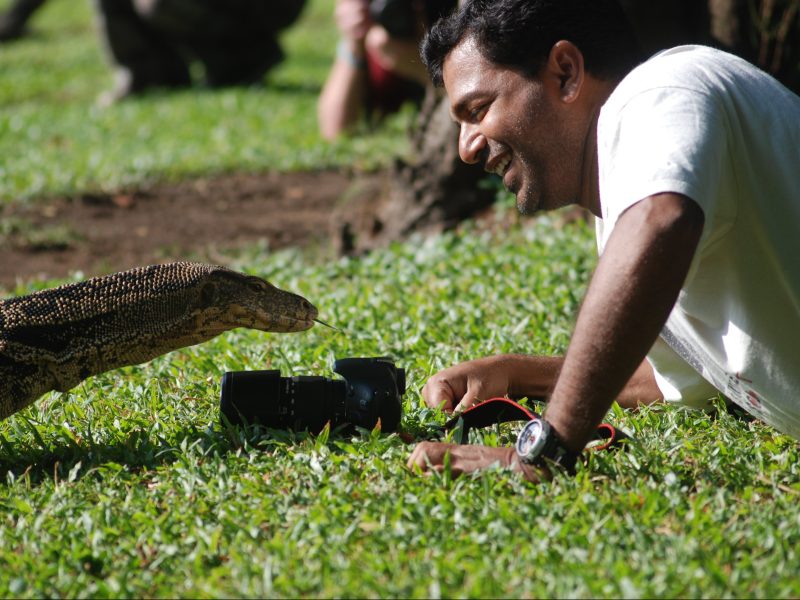


Man-animal conflict in India varies widely, with each scenario presenting unique challenges due to local geography and demography. These complex issues often consume the energy of wildlife biologists and conservationists as they work to resolve them across the country. Among these conflicts, man-snake encounters stand out for their daunting challenges and have been largely overlooked, despite causing catastrophic loss of life and severe health impacts. One stark statistic illustrates the gravity of this issue: snakebites cause more human deaths in India than all other forms of man-animal conflict combined.
India has earned the unfortunate title of ‘snakebite capital of the world’, accounting for roughly half of global snakebite deaths. The World Health Organization (WHO) has classified snakebites as a ‘neglected tropical disease’.
In this talk, Gerry Martin, Karthik Sunagar, and Sumanth Bindumadhav will share their insights on the snakebite crisis and how it can be prevented. The presentation will be followed by a Q&A session with the audience.
Speakers
Gerry Martin
Over the last two and a half decades, Gerry Martin have been involved with herpetological research and conservation, documentary filmmaking, education and teacher training and eco-tourism. His professional career started in 1995 when I joined Rom Whitaker at the Madras Crocodile Bank Trust/ Centre for Herpetology near Chennai on the East coast of India. Soon, he started working on the king cobra breeding program that Rom had started along with his award-winning film, King Cobra that airs on the National Geographic Channel.
This introduced him to the world of wildlife filmmaking. Soon after, Gerry worked with Paramount Pictures on their series, ‘Wild Things’, Fox TV on ‘World Gone Wild’, BBC’s ‘Land of the Tiger’ and a few others. Through these programs, he was on-camera talent, consultant and animal handler.
In 2010, he started The Gerry Martin Project, bringing all the conservation and education work that he does under one umbrella. Gerry, along with his wife, Chandini have set up The Liana Trust. The Trust brings together both thier skillsets of wildlife conservation, educational reform, conflict mitigation and herpetological research and expertise.
Sumanth Bindumadhav
Sumanth Bindumadhav has worked on several facets of wildlife conservation for nearly two decades. He started his career with rescue and rehabilitation of injured and displaced urban wildlife before he began continual efforts to build capacity of the law enforcement and custodian agencies on various elements of dealing with the daily interactions between humans and wild animals. He has a particular interest towards community led conservation initiatives- especially as it relates to conflict with snakes among other species.
Over the last decade his work with leading herpetologists and researchers in the country has contributed to a significantly better understanding of the dynamics of conflict itself. In addition, he has a decade of experience in detection, prevention, and rescue of wild animals from illegal wildlife trade. He spearheaded the intervention that put a halt to sale of wild animals at the century old Sonepur Mela, Bihar, rescued conservation dependant species such as pangolins and lorises from trade and continues to work on policy and advocacy centric interventions that seeks to regulate domestic and international trade of exotic and endemic wildlife as it relates to CITES and various other conventions and treaties.
He serves as faculty for several institutions on animal law including NALSAR University of Law, several state judicial academies and the National Judicial Academy. In his current role with Humane Society International/India, he leads the organizations wildlife protection department which is focused on developing model solutions to human-snake conflict, human-elephant conflict, conservation of olive ridley turtles, and systemic capacity and capability building of various stakeholders.
Kartik Sunagar
Prof. Sunagar is a Wellcome Trust DBT India Alliance Fellow and an Associate Professor at the Centre for Ecological Sciences, Indian Institute of Science, Bangalore. He is the founder of the Evolutionary Venomics Lab and the Director of Venom Institute for Snakebite Health and Advanced Medicine (or VISHAM), a state-of-the-art serpentarium for snakebite education and research being established in Bangalore. His group investigates the influence of ecological and evolutionary processes that shape animal venoms. Prof. Sunagar’s lab is also working towards developing next-generation snakebite treatment for India and sub-Saharan Africa.
Prof. Sunagar has been conferred with several awards and recognition, including the Wellcome Trust DBT India Alliance Fellowship, Ramanujan Fellowship, Professor Har Swarup Memorial Award, INSA Medal for Young Scientist, DST-INSPIRE Faculty Award, Discovery Early Career Researcher Award, Marie Curie Fellowship, Merck Young Scientist Award, among others. He has served on the advisory committees for various government and private organisations, including World Health Organisation, Ministry of Health and Family Welfare, Department of Biotechnology, Indian Council of Medical Research, among others. He has over 84 publications in international peer-reviewed journals with 4750+ citations and an h-index of 34.
