
- This event is over. However, time travel possible through our Audio & Video! See upcoming events
Secrets and Lines: A Short History of Boundaries in India
The 2026 Obaid Siddiqi Lectures
Speaker
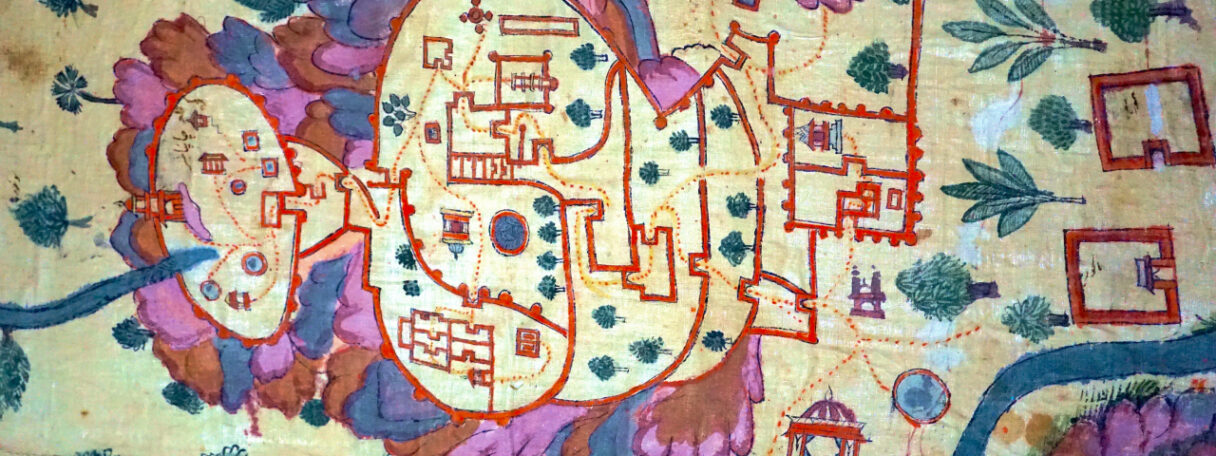
People never stop remaking the spaces they inhabit, in languages and materials that shift with the times. In early modern India, spatial practice encoded segregation and hierarchy, but it also carried pleasure, beauty, and affect.
From the nineteenth century, India’s mapping history hardened into rigid visual, legal, and administrative lines, often stripping out affect while retaining older structures of power. Historian Samira Sheikh, Associate Professor at Vanderbilt University and the current Obaid Siddiqi Chair in the History and Culture of Science, will deliver this year’s lecture series tracing that very history: from the missing archive of early modern mapping to the moment political boundaries entered Indian cartography. This final lecture completes the arc, uncovering what survived beneath these lines.
What happens to older spatial knowledge when a state redraws its lines? Where does affect go when power hardens into the administrative and the legal? And what does it mean for a practice to survive by living beneath, beside, and within a new order?
This lecture is part of the Obaid Siddiqi Lectures, delivered annually by the Obaid Siddiqi Chair in the History and Culture of Science at the Archives at NCBS.
Image Credit: Painted textile map of Gujarat (detail, Champaner–Pavagadh). 18th century, Baroda Museum and Picture Gallery, Vadodara. Object no. GR 5631.
In collaboration with


Venue: Auditorium
Speaker
Samira Sheikh
Dr Samira Sheikh is a historian of South Asia and Associate Professor of History at Vanderbilt University. She is currently the Fifth Obaid Siddiqi Chair at the Archives at NCBS. Her research focuses on early modern and modern western India, with particular attention to Gujarat, riverine and coastal histories, mapping, and the social worlds of trade, labour, and governance. She is the author of Forging a Region: Sultans, Traders, and Pilgrims in Gujarat, 1200–1500 and is currently working on two book projects on mapping and mapmaking in South Asia. Her work combines archival research with spatial and digital methods to rethink how Indian spaces were historically known and made.
